Troubleshooting Hiking Shoes on the Trail
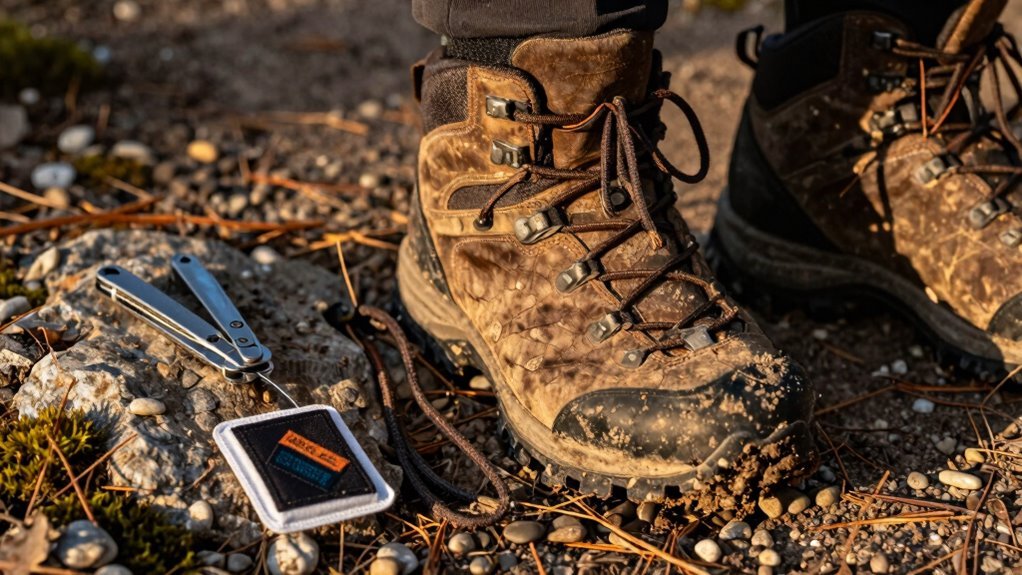
Feel that hot spot? Stop now—don’t tough it out. Slap on tape or moleskin, dab iodine, and breathe easy.
Snapped lace? Seal it with Shoe Goo or a flame—boom, fixed. Sole flapping like a fish? Duct tape’s your trail buddy.
Heel slipping? Lock it down with a loop lace trick. Wet hiking shoes? Air them out, never fry them.
Stay smart, stay comfy, and laugh off the little disasters—your next adventure’s got nothing on you. There’s more where that came from.
Dealing With Blisters and Hot Spots
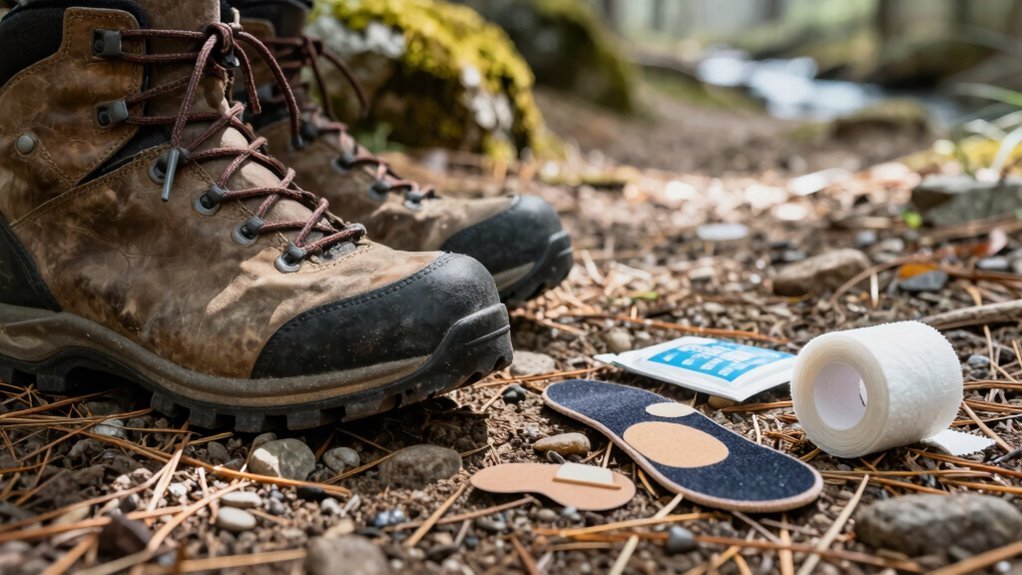
Spotting hot spots early is like catching a tiny villain before it turns into a full-blown blister baddie—so don’t wait until it’s too late.
The second you feel that telltale rub or warmth, stop and act.
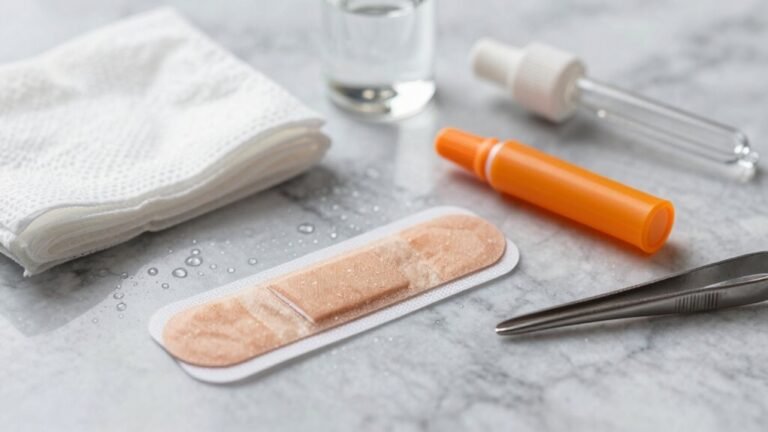
Rip off your sock (yes, right there on the trail—no shame!) and slap on some adhesive tape or moleskin.
It’s like a tiny force field for your foot.
Dab on iodine first to keep germs away, and maybe a dash of benzoin to make that tape stick like glue.
If you’ve got liner socks and wool or synthetic layers, you’re already winning—those wick moisture like magic.
And hey, if a blister pops up anyway, drain it gently with a clean needle, cover it with molefoam, and seal it in with gauze and tape.
Treat your feet like VIPs, and they’ll carry you happily for miles.
Consider switching to trail runners for better breathability and reduced moisture buildup.
Fixing Loose or Broken Laces
When your laces start fraying or snap mid-hike, don’t just stand there looking at them like they’ve betrayed you—grab a fix before your boots turn into slippers.
Wrap the frayed end with clear tape for a quick patch, or seal it with Shoe Goo to keep water and fraying at bay.
If you’ve got superglue and a scrap of plastic bag, clamp the lace with polyethylene to stop it from sticking where it shouldn’t—smart and cheap!
For a tougher fix, slide on heat shrink tubing, add a dab of glue, and shrink it with a lighter for a rock-solid aglet. Choose tubing with dual-wall tubing for maximum security and durability.
Or, carefully melt nylon laces with a flame—five seconds, smooth it out, and boom: instant seal.
These tricks aren’t haute couture, but they’ll get you home without tripping over your own boots.
Stay sharp, stay steady, and keep lacing forward!
Addressing Sole Separation Mid-Hike
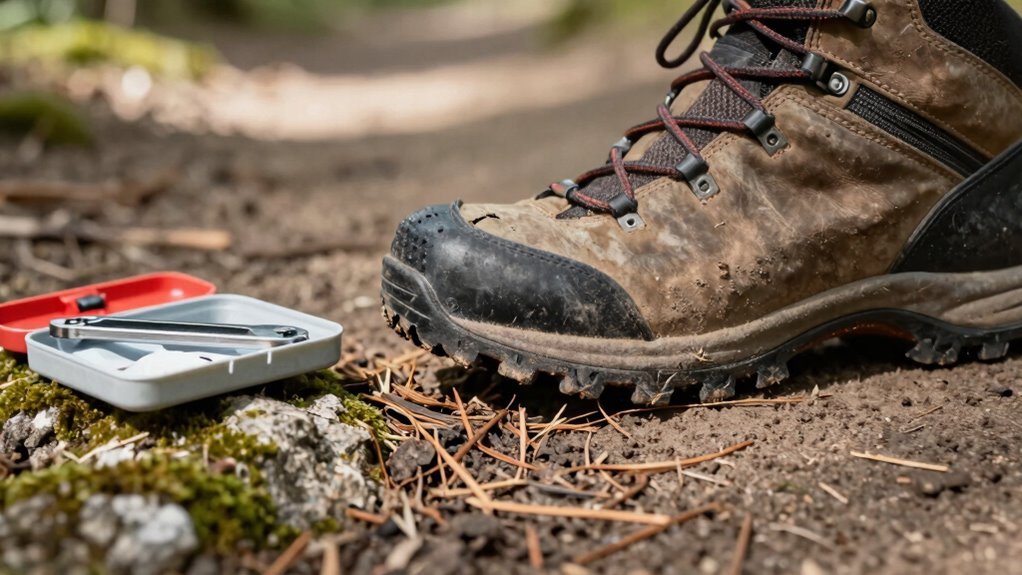
Even if you didn’t pack a full repair kit, you’re not helpless when your sole starts peeling away like a sunburnt fingertip. Grab a strong needle and thread if you’ve got one—stitching the sole back buys you time.
No thread? Slather on any strong glue you have, press it firm, and let it dry as long as you can stand it. Taping the spot with duct tape or packing tape helps hold it together while you hike.
Avoid rocky drops or scrambling—give your shoes a break. And whatever you do, don’t toss them in the washer later; that’ll make it worse.
Once you’re back, hit a cobbler or contact the maker—many fix or replace shoes within 500 miles.
Think of it as a battle scar, not a failure. Your shoe’s not done yet—it’s just asking for a little love.
This kind of failure often stems from midsole failure, the most common point of separation in hiking footwear.
Preventing and Managing Heel Slippage
If your heel’s doing the cha-cha every time you step, you’re not stuck with a waltz up the trail and down again—let’s nail that fit.
Start by testing shoes on an incline or stairs with your trail socks and insoles; you want a snug heel and half to three-quarters of an inch of toe room.
If your heel pops out, the boot’s likely too big—or your laces are slacking.
Try a loop lock: lace to the flex point, tie a knot, then pull tight up top.
Works like magic.
Narrow heels? Boost grip with aftermarket insoles or heel liners—Dr. Scholl’s sticks great.
Avoid thick insoles that lift your foot; they’ll just add slip and side-to-side shimmy.
Break in your boots—your body weight molds the heel cup over time.
And skip extra sock layers; more movement means more blisters.
With the right combo of fit, lacing, and liners, your heel stays put, not in a dance-off every step.
Handling Wet or Water-Damaged Shoes
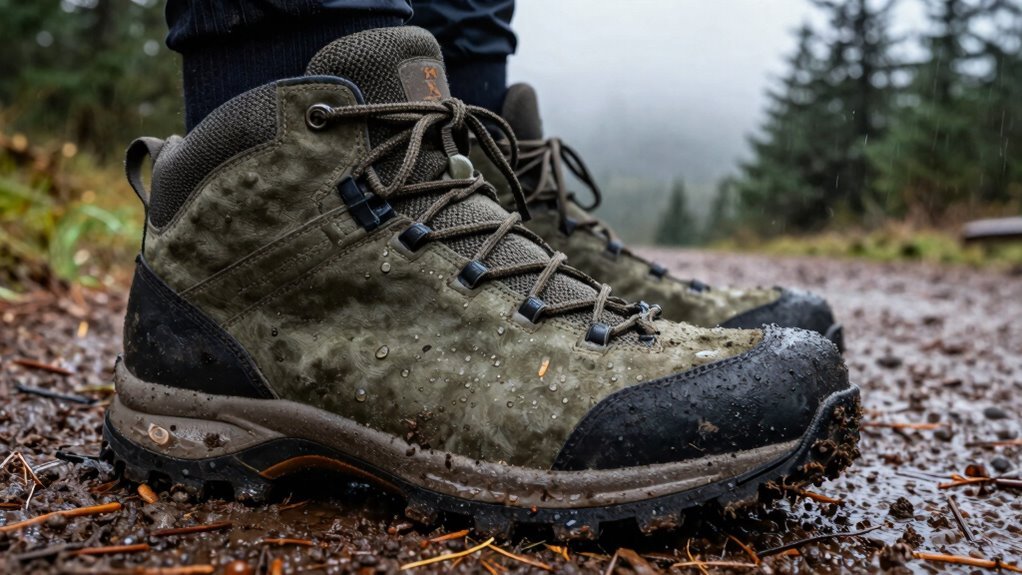
Though water crossings and surprise downpours are part of the adventure, soggy shoes don’t have to be your trail sidekick—dry feet keep the fun going.
Flip your boots upside down at camp to drain and air out overnight—hello, chimney effect!
Pull out insoles so they dry separately, because damp socks meet swampy insides? No thanks.
Never roast them by the fire—you’ll cook your kicks.
After hiking, brush off dried mud like you’re grooming a stubborn pony.
Back home, hand-wash with a gentle scrub and Nikwax cleaner, then let them nap in the shade.
Skip the washing machine—it’s basically a shoe blender.
Re-waterproof with spray or wax after cleaning, and patch peeling soles with Seam Grip, weighting them like a sandwich press.
Treat your boots right, and they’ll keep your feet happy, not soggy—because nobody likes walking in puddles they didn’t sign up for.
Frequently Asked Questions
Can I Use Duct Tape for Long-Term Sole Repairs?
No, you can’t rely on duct tape for long-term sole repairs—it’ll quit on you when you need it most.
Sunlight kills the adhesive, dirt gums it up, and eventually, it peels off, leaving a sticky mess.
Sure, it’s a trail hero in a pinch, but for real staying power, grab something like Seam Grip or Freesole.
Your boots (and toes) will thank you when you’re still hiking strong—no tape flapping in the wind like a lost flag!
How Do I Stop My Insoles From Bunching Up?
Bunching? Trim your insoles to fit snugly, following the shoe’s shape like a puzzle piece.
Use sharp scissors, match the outline, and slice smoothly for a seamless setup.
Pick tapered designs—they tuck in tight without twists or tumbles.
Pair with thin wool socks, press firmly, and pocket double-sided tape for extra hold.
No bunch? No trouble—just blissful, bumpy-path striding!
Is It Safe to Dry Hiking Shoes With a Hairdryer?
No, you shouldn’t dry hiking shoes with a hairdryer—it’s way too harsh!
The hot air warps leather, weakens glue, and makes materials brittle.
Think of it like blow-drying a snowman—things melt, crack, or shrink fast!
If you’re stuck, use it on low, from far away, and only in emergencies.
But seriously, skip it when possible.
Air drying’s safer and won’t toast your boots like a campfire snack!
What Should I Do if My Shoe’s Eyelets Rip?
You’re hiking, lace in hand, eyelet ripped—don’t panic!
Grab spare cord or a doubled drawstring, thread it through the tear, and tie it down, using at least 4 inches per side for strength.
Slap on duct tape over the hole to keep things snug.
If you’ve got a shock cord loop and cordlock, tuck the lace end in—it’s a clever little hack.
You’ve got this, MacGyver!
Can I Hike Barefoot if My Shoes Fail Completely?
Nope, you can’t hike barefoot if your shoes fail—don’t even think it!
Trail terrain’s sneaky, hiding sharp rocks, hot sand, and who-knows-what in the mud.
Your soles aren’t invincible, and one nasty cut could mean trouble.
Plus, bacteria love foot wounds.
Wrap your feet in something—socks, a jacket, duct tape armor, whatever works!
Safety first, barefoot rebel.
Save the shoeless strolls for safer spots.
Conclusion
You’ve got this—think of your hiking shoes like trusty campfire marshmallow sticks: sometimes they char, bend, or even snap, but you can still roast a sweet adventure. Blister? Sort it. Loose lace? Tighten it. Wet soles? Shake it off. With a few quick fixes, you’re back in step, laughing at the mud and soaking in the views—because every hiccup’s just part of the trail’s punchline.
References
- https://www.sixmoondesigns.com/blogs/newsletter/the-blister-queens-guide-to-treating-blisters-while-trekking-by-raquel-mogado
- https://www.rei.com/learn/expert-advice/blister-prevention-care.html
- https://www.thehiking.club/blog/blister-management-for-hikers
- https://www.outdoors.org/resources/amc-outdoors/outdoor-resources/blister-treatment-when-hiking/
- https://seatosummit.com/blogs/adventure-tips/tips-hikers-preventing-treating-blisters
- https://www.salomon.com/en-nl/sg/a/how-to-prevent-blisters-when-hiking
- https://weareexplorers.co/how-to-stop-blisters/
- https://www.fieggen.com/shoelace/agletheatshrink.htm
- https://www.youtube.com/watch?v=FrsSnXx4Zik
- https://www.youtube.com/watch?v=onsiCclOxdQ