Satellite Messengers Explained Simply
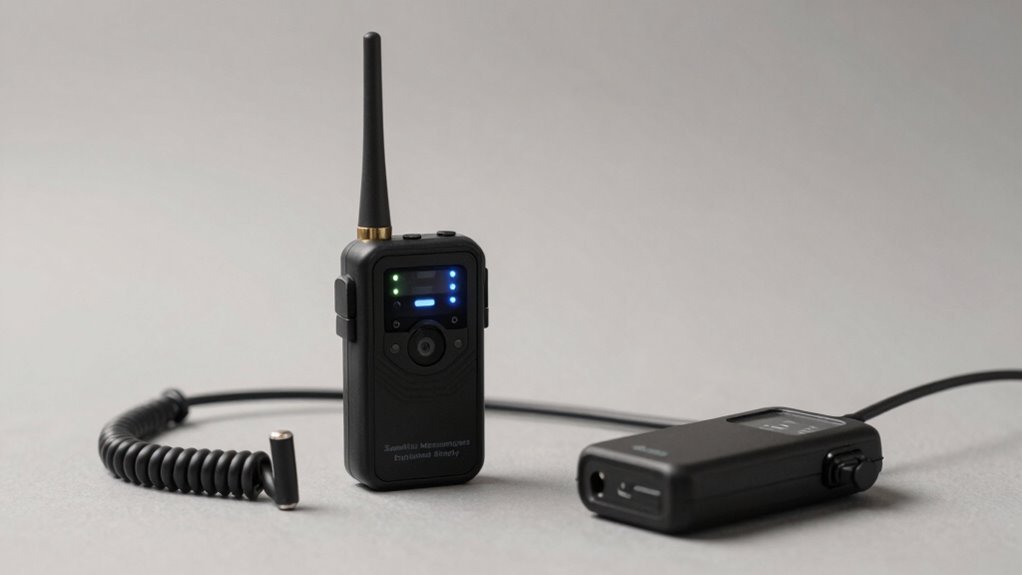
When your phone gives up, your satellite messenger keeps going—just type a text, tap SOS, or check in from the middle of nowhere. It shoots your message to space, bounces it off orbiting satellites, and sends it home, even in storms or deep canyons.
These pocket-sized pals love adventures, survive drops and dunks, and last for days on a charge. You’ll stay connected with help, humor, and a lifeline that never quits—there’s plenty more where that came from.
What Is a Satellite Messenger?
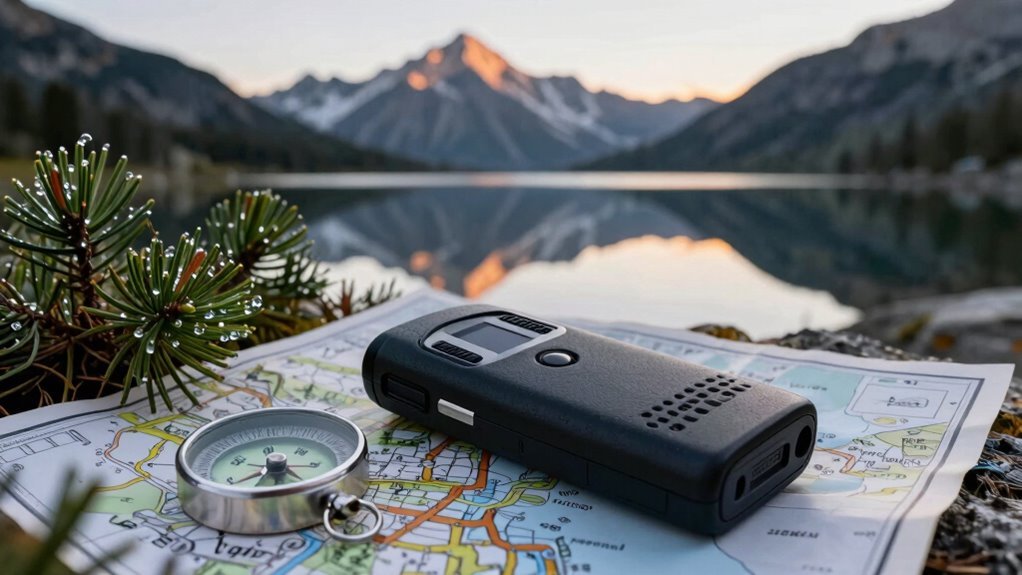
Ever wonder how you can send a message from the middle of nowhere—like a mountain ridge or a remote desert—where your phone hasn’t got a single bar?
That’s where your trusty satellite messenger comes in. You use it to text, check in, or call for help when there’s no cell service—because, newsflash: satellites don’t care how remote you are!
These compact gadgets beam your messages to orbiting satellites, then down to rescue teams, family, or even your buddy’s phone. Some let you send replies, get weather updates, or share your GPS dot on a map.
Sure, they need a sky view (trees hate them) and a subscription (space isn’t free!), but hey—it beats yelling into the void. Whether you’re hiking, working remotely, or just avoiding small talk, this little device keeps you connected—no bars required.
They work by connecting directly to GEO or LEO satellites.
How Do Satellite Messengers Work?
You’re out where cell signals quit and even the birds seem out of range, but that little gadget in your pocket is still ready to talk—thanks to a network of high-flying satellites doing the heavy lifting.
You press a button, and your message zips up to low-Earth orbit satellites, bouncing across systems like Iridium (hello, poles!) or Globalstar (sorry, Antarctica, we’ll check the map).
Your device grabs your GPS spot, then fires off that text or SOS with a clear view of the sky—trees hate that part.
SOS alerts get VIP treatment on a special channel, so help gets called fast.
Meanwhile, your “I’m alive!” texts ride the same cosmic highway to loved ones, with replies popping up when satellites swing by.
Sure, it’s not Wi-Fi speed, but hey, it works from the middle of nowhere. Pretty cool, right?
And with global satellite coverage, even the most remote corners of the planet stay within reach.
Key Features of Satellite Messaging Devices
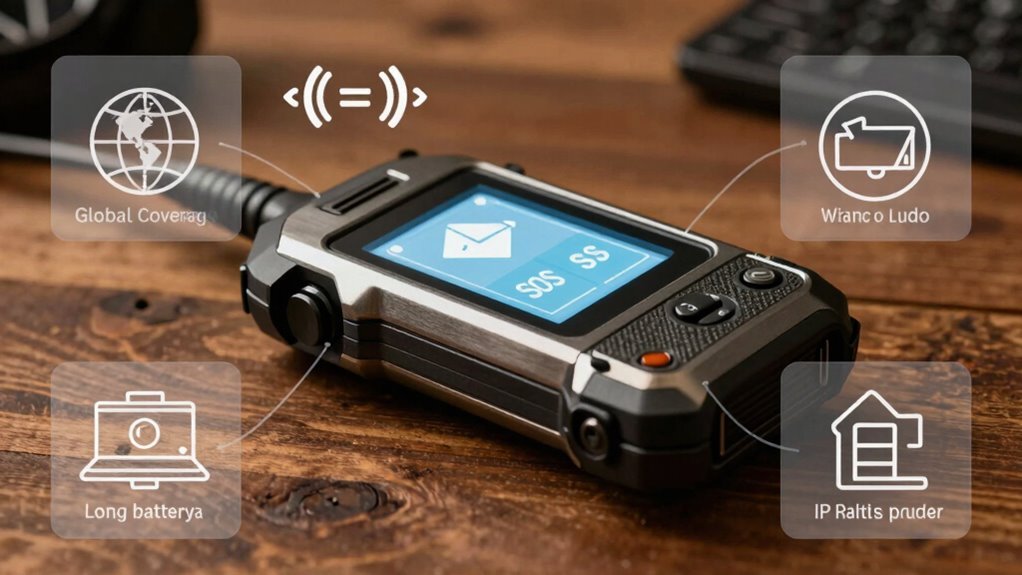
What makes a tiny device worth its weight when you’re miles from the nearest signal? You bet it’s the features packed into these tough little lifesavers.
They’re light, smart, and built to survive your wildest adventures—rain, drop, or snow.
- Pocket-Sized Powerhouses: Weighing as little as 4.1 oz, devices like the Garmin inReach fit in your palm but pack global satellite coverage.
- Built Like a Tank: With IP67/IP68 ratings and MIL-STD toughness, they laugh at mud, drops, and dunkings.
- Battery That Won’t Quit: Get hundreds of hours on a charge—ZOLEO lasts over 200 hours, and some can even charge your phone!
- Smart & Connected: Use your smartphone for two-way texts, share voice memos, or hit SOS with just a tap.
Users can also send and receive messages globally through a free companion app, enabling seamless communication via ZOLEO App connectivity.
Now *that’s* peace of mind you can carry.
When You Might Need a Satellite Messenger
When the trail fades behind you and your phone shows nothing but ghost bars, that’s when your satellite messenger earns its spot in your pack.
You’re deep in the backcountry, miles from help, and a twisted ankle turns your adventure dicey—hit SOS, and GEOS alerts rescuers with your exact GPS spot.
Even if you can’t reply, help still comes.
Heading into canyons or dense forests? Iridium’s global network’s got your back, no cell needed.
Long hike? Track your path every 10 minutes and share check-ins with loved ones.
Battery lasts 50 hours, and you can send quick updates like “Still alive—just grumpy!”
Pair it with maps on the app, set waypoints, and never worry about your phone dying.
Whether you’re off-grid for days or just playing it smart, this little gadget’s like a worry-free hiking buddy.
Sweet, right?
Differences Between Satellite Messengers and Cell Phones
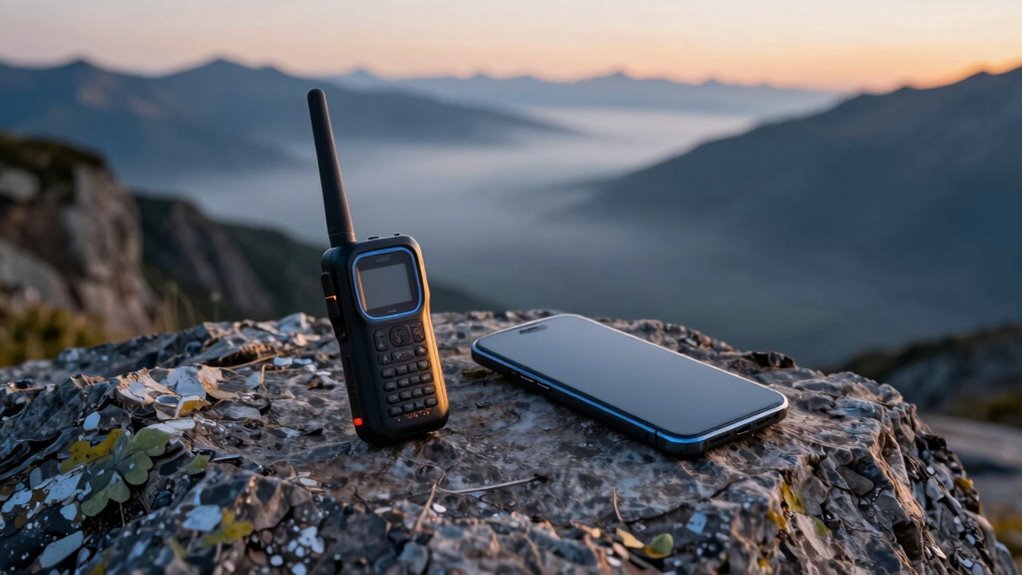
Ever wonder how you can text from the middle of nowhere without a single cell tower in sight?
That’s the magic of satellite messengers—your phone just can’t do that!
While your cell phone relies on nearby towers (and throws a fit when they’re gone), satellite messengers talk straight to orbiting satellites.
Here’s what sets them apart:
- Connection: You text via satellite, not cell towers—perfect when you’re off-grid.
- Coverage: You stay connected in wild, remote, or even polar zones where phones fail.
- Function: You send SOS alerts and track your location, but no cat videos or calls.
- Battery: You get days—or even weeks—of power, so you’re not scrambling for a charger.
Popular Uses for Satellite Messengers
Now that you’ve seen how satellite messengers outshine cell phones when you’re off the grid, let’s talk about how people actually use these handy little heroes. You can send SOS alerts with the push of a button—help comes faster when your device shares your exact spot, even at the North Pole.
Need to text family from a mountain? No problem. Two-way messaging keeps you chatting through apps, and you can even share your live location so loved ones know you’re safe (and not being chased by bears).
Friends on group trips use GroupTrack to stay in sync, while anglers and hikers send weather updates and silly check-in notes. With real forecasts in your pocket, you’ll dodge storms like a pro.
Devices double as your global bestie—sending texts, sharing locations, and making sure you’re never *too* lost. Who knew safety could be this fun?
Choosing the Right Satellite Messenger for Your Needs
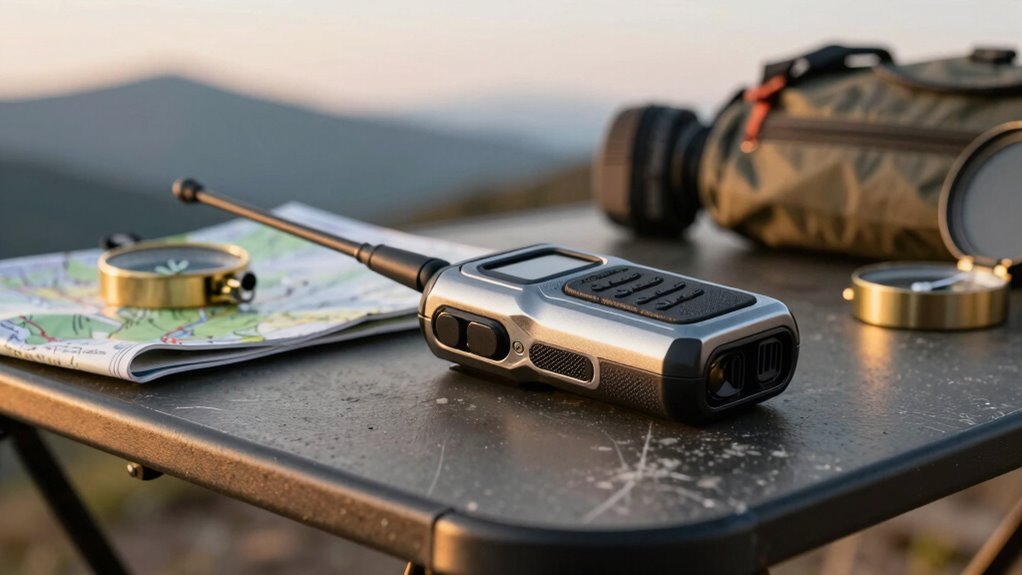
What kind of adventurer are you—light on your feet and deep in the backcountry, or fully geared up for a global trek with all the bells and whistles?
Pick a device that matches your style, whether you’re chasing sunsets or just want peace of mind.
- Need ultra-light? Go for the Motorola Defy (2.5 oz) or Garmin Mini 2 (3.5 oz).
- Planning international routes? Stick with Iridium’s global coverage—Garmin and ZOLEO have your back, pole to pole.
- Love full features? Try the SPOT X with its keyboard or Garmin Montana for built-in maps and navigation.
- Want long battery life? The inReach Messenger Plus lasts 25 days, while SPOT X gives 240 hours—perfect for month-long missions.
Choose smart, stay connected, and let your messenger keep up with your wild side—because getting lost should be optional, not dangerous.
Understanding Subscription Plans and Coverage
Picking the right satellite messenger isn’t just about size, weight, or which one fits snugly in your pack—it’s also about knowing how much you’ll actually pay to stay connected when the trail runs out and the views get wild.
You’ve got options: ZOLEO starts at $20/month with 75 messages, while Garmin inReach dips to $15/month with just 10.
Need unlimited chats? That’ll be $50 either way.
Run over your limit? ZOLEO charges 50¢ per extra message—ouch!
Both use the reliable Iridium network for global two-way texting and SOS alerts (yes, 24/7 rescue is included).
Oh, and check-ins? Unlimited on all plans—nice!
But watch the small print: suspend your Garmin? No monthly fee, but a $40 wake-up call to reactivate.
ZOLEO charges $4 to snooze your plan—cheaper nap, really.
Use cost calculators to compare, crunch numbers, and avoid subscription surprises.
Your future self (and wallet) will thank you.
Frequently Asked Questions
Can Satellite Messengers Work Indoors?
Nope, you can’t reliably use standard satellite messengers indoors—you need a clear view of the sky to connect.
Walls and roofs block their signals, so step outside for that text or SOS.
But hey, if you’re stuck inside, some newer tech like AT&T’s AST SpaceMobile might save the day soon—no stepping out required!
For now, just peek at the sky, thumbs up, and send from there.
Easy.
Do They Require a SIM Card?
No, they don’t need a SIM card—you’re good to go right out of the box!
Satellite messengers like SPOT or SmartOne C come with built-in connectivity, so you skip the hassle of swapping cards or hunting for signal.
Just power on, send a message, or call for help from nearly anywhere on Earth.
Think of it as a walkie-talkie with superpowers—no SIM required, no drama, just adventure-ready communication in your pocket.
Fun, right?
Are Messages Encrypted for Privacy?
Oh, sure, your messages are *totally* private—unless someone’s listening in from space with a laptop and a snack!
Most satellite messengers don’t encrypt by default, so your chat might travel like a postcard on steroids.
But hey, you *can* lock things down using apps like Signal or a good VPN—because nothing says “I’m serious about privacy” like outsmarting hackers from orbit!
Can I Use One Internationally?
Yeah, you can totally use one internationally—most satellite messengers work across the globe!
Iridium-based devices like Garmin inReach even cover the poles, so you’re set whether you’re trekking Antarctica or island-hopping.
Just check local rules; some countries restrict satellite gear.
Globalstar devices, like SPOT, have spotty coverage near the poles, so pack accordingly.
Either way, you’ll stay connected, safe, and ready for adventure—no cell tower needed!
How Long Does the Battery Last?
It lasts a long time—you could hike the entire Appalachian Trail and barely need a recharge!
The Garmin inReach Messenger lasts up to 28 days tracking every 10 minutes, even in freezing temps.
It only drained 5% a day in tests, so on a 5-day trip, you’d use under 30%.
Plus, it charges via USB-C and can even juice up your phone.
Now that’s what I call power!
Conclusion
You’re the captain of your own adventure, and a satellite messenger? That’s your trusty compass in your back pocket. When cell signals vanish like snacks at a campfire, this little hero stays strong, connecting you to help or home with a wink and a text. Rain or shine, mountain or maze, it’s got your back—like a pocket-sized guardian angel, minus the halo, plus GPS. Stay safe, stay linked, and let the wild stay wild.
References
- https://www.acrartex.com/news/satellite-messenger-101-how-they-work-and-why-you-need-one/
- https://www.switchbacktravel.com/best-satellite-messengers
- https://www.overwatchxrescue.com/trending/technology/understanding-the-difference-between-a-satellite-communicator-and-gps/
- https://en.wikipedia.org/wiki/SPOT_Satellite_Messenger
- https://www.youtube.com/watch?v=YD1TTyEYWpE
- https://www.treelinereview.com/gearreviews/best-personal-locator-beacons
- https://coloradosar.org/plbs-and-satellite-messaging-devices-a-primer/
- https://gpstraining.co.uk/blogs/reviews/two-way-satellite-communicators-which-is-best
- https://www.ordealist.com/satellite-messengers/
- https://en.wikipedia.org/wiki/Satellite_emergency_notification_device