Headlamp Lumens: How Bright You Really Need
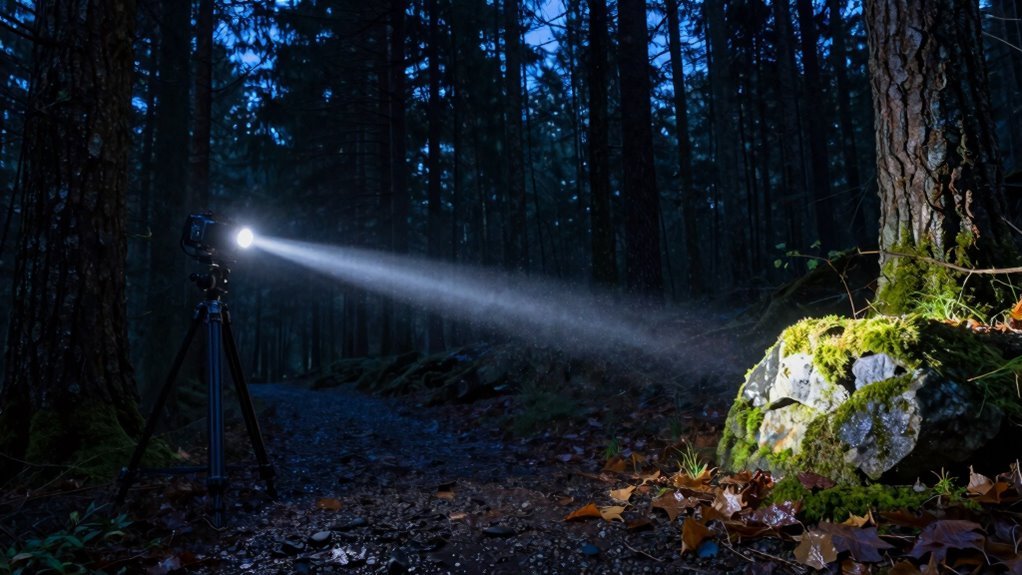
Headlamp lumens are a key factor in choosing the right light for your outdoor adventures. For most night hikes, 300 to 500 lumens is plenty, providing clear trail vision without draining your battery too quickly.
Dial down to 50–100 lumens for camp tasks like cooking or reading. Using red or warm light settings helps preserve night vision and keeps your companions from being blinded.
Spot beams are ideal for seeing distant trail features, while flood beams illuminate your immediate workspace. Many headlamps offer smart mode switching to balance brightness and battery life.
Save boost mode for emergencies, like spotting a lost trail marker or finding your misplaced snack. With the right use of headlamp lumens, you’ll have reliable light when you need it most.
Understanding Lumens: What They Measure and Why It Matters
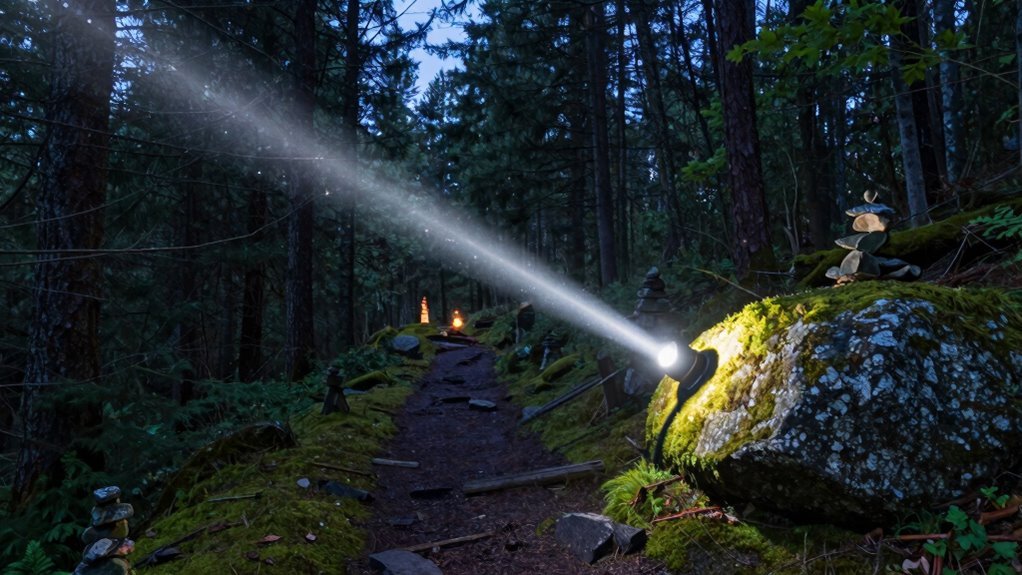
Ever wonder why some headlamps light up the trail like daylight while others barely let you see your toes?
That’s lumens at work—your brightness buddy.
Lumens measure how much visible light your headlamp blasts out, not energy used.
More lumens mean brighter light, so you’re not stumbling over roots like a zombie.
Unlike watts (old school!), lumens tell you actual brightness, no guesswork.
Think of it this way: 1 watt of green light at the perfect wavelength gives you a whopping 683 lumens—yep, green’s the MVP.
Measured in special spheres, lumens account for how your eyes see light, so what matters most is what *you* see.
Whether you’re reading a map or sprinting down a trail, lumens help you pick the right beam.
Skip the watt nostalgia—lumens are where it’s at.
Lumens, not watts, determine brightness
Brightness clarity? You’ve got it!
Low Light Needs: When Fewer Lumens Are Better
When you’re not trying to beam light to the moon, dialing down the brightness actually works in your favor—because sometimes, less is seriously more.
You don’t need a spotlight to read a map or fix a zipper at camp, right?
Crank it down to 5–150 lumens and save your eyes (and your battery).
Low settings cut glare, keep your night vision sharp, and won’t blind your buddy across the tent—always a win.
Warm or red light modes? Even better for late-night reading without the headache.
Plus, flood beams spread light evenly, so you’re not squinting at shadows.
Whether you’re tinkering with gear, gardening, or just fumbling for snacks, low lumens give you hours of runtime, especially with rechargeables.
Adjustable modes mean you’re in control, using only what you need.
Low-lumen range (50-150) is ideal for close-up tasks where excessive brightness isn’t necessary.
So go ahead—keep it dim.
Your eyes, your campsite, and your battery will thank you.
Less light? More awesome.
Ideal Brightness for Night Hiking and Trail Use
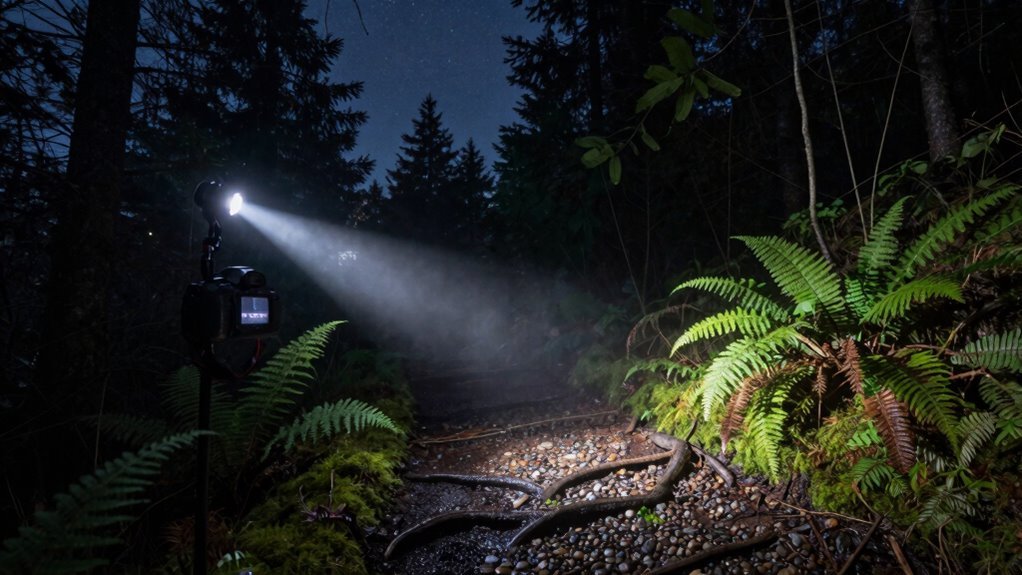
How’s this for peace of mind: you’re deep on a backwoods trail, and your headlamp cuts a clean path through the dark without guzzling battery life. You’re moving at a normal pace, not crawling, thanks to 300–500 lumens—sweet spot territory. It’s bright enough to read the trail ahead, spot roots and rocks, and keep your footing solid, especially on rugged or unfamiliar ground.
A focused or spot beam works best, projecting light farther so you’re not tripping over surprises. While 200 lumens gets some folks through, pushing to 300 gives you confidence, not just coverage.
And here’s the kicker: modern lights at 400 lumens can last over 20 hours, so you won’t be left in the dark halfway back.
Don’t overbuy—870 lumens is great, but 500’s plenty for most trails. You want clarity, safety, and a full charge by dawn. Bright enough, not bonkers.
Many high-lumen models use USB-rechargeable batteries, balancing brightness with sustainable power over long outings.
Camping Tasks and the Right Lumen Range
You’ve nailed the trail with a bright, steady beam guiding your footing—now it’s time to settle in and make camp without turning night into day.
For most camping tasks, you don’t need a spotlight—just the right amount of cozy, functional light.
Keep it low and practical so you’re not blinding your buddy or ruining your night vision.
- Use 30–100 lumens to pitch your tent or sort gear—plenty of glow without the glare
- Cook like a pro with 50–100 lumens and a flood beam; even s’more prep needs good lighting
- Read maps or novels under 100 lumens, or switch to red light so your eyes stay night-ready
- Walk around camp easily with 100–200 lumens—spot roots, rocks, and rogue marshmallows
- Tackle repairs or small jobs at under 150 lumens, saving battery while staying efficient
Running and Fast-Paced Activities: Balancing Brightness and Battery
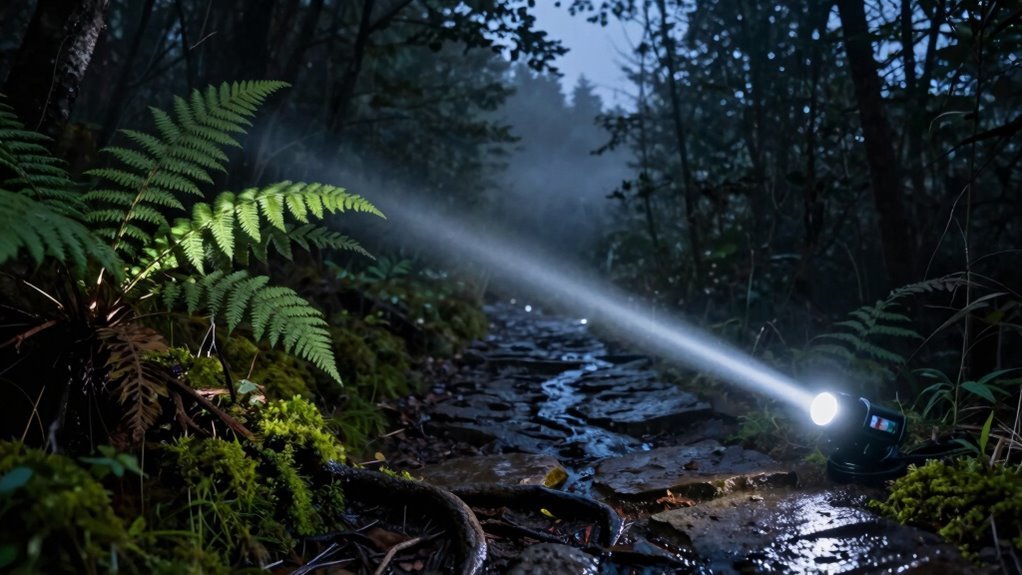
Though the trail might vanish behind you with every step, a good headlamp keeps your path clear and your pace confident—because nobody wants to trade speed for stumbling.
For most runs, 200–300 lumens is sweet: bright enough to dodge roots, light enough to save battery.
Tackle technical terrain? Bump it to 500–800 lumens, but don’t get greedy—peak brightness burns out fast.
You want sustained lumens, not a flashy sprint that dies in 20 minutes.
Need 90 minutes of solid light? Aim for 650 lumens steady.
Going long? 400 lumens can last 3+ hours.
And remember, heavier 600+ lumen beasts drain battery *and* your neck—fine for pros, overkill for most.
Start with 300 if you’re new; as you adapt, you’ll need less light to fly.
Pick smart, run bright, and keep the fumbles for flat ground.
How Distance and Beam Focus Affect Performance
You’re flying down the trail, headlamp cutting through the dark like a flashlight saber—just don’t get cocky and trip over your own feet.
Beam distance matters: the Fenix HP25R hits 182m, while the Zebralight H600w stays bright for hours.
But distance alone won’t save you—focus and pattern shape your view.
A narrow beam like the Vitchelo V800’s may reach far, but it’s bad at lighting up the trail around you.
Glare from intense beams can help or hurt, so balance is key.
Whether you’re climbing, skiing, or inspecting gear, your beam should match the task.
- Pick wide beams for close work, narrow for distance
- Adjust focus to switch between trail and detail
- Watch for hot spots or blurry rings that distract
- Higher intensity = more visibility (and some glare)
- Swivel heads help mechanics aim light hands-free
Battery Life vs. Brightness: Finding the Right Trade-Off
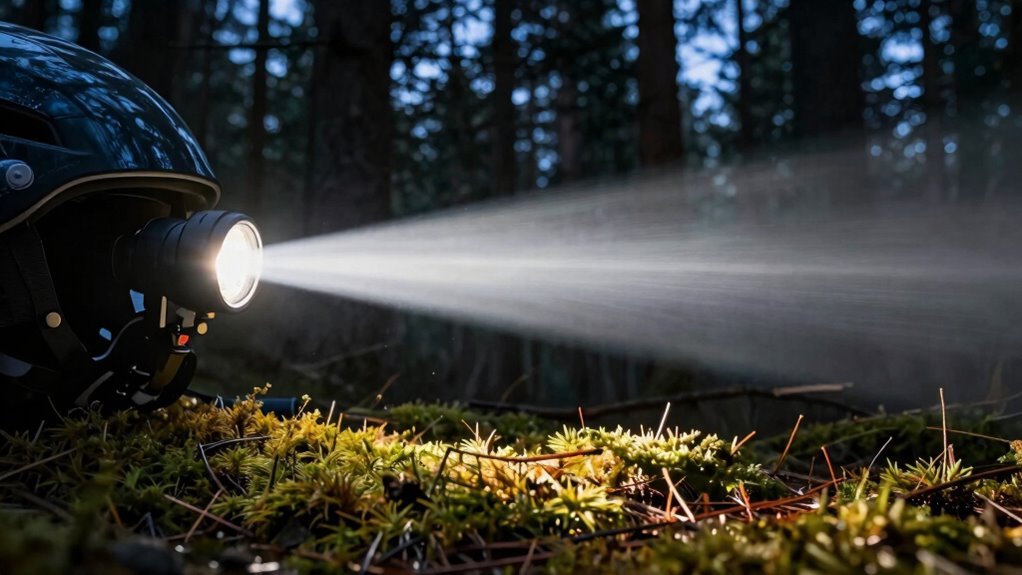
What’s the point of a blazing-bright beam if your headlamp conks out halfway up the trail?
You’re left fumbling in the dark like a confused raccoon.
High-lumen modes dazzle—sure—but they drain fast.
The Petzl Actik Core, for example, gives you just 2 hours at 450 lumens.
Ouch.
But drop to 100 lumens, and it lasts 8 hours.
Sweet deal.
Bigger batteries or lithium-ion power, like in the BioLite Range 400, stretch that further—6 hours on high, a whopping 200 on low.
Need brightness?
Go for models with dual batteries or USB rechargeability.
But for most trails, 300 lumens is plenty—and kinder to your battery.
Think of it like driving: floor it, and you’ll run out of gas fast.
Cruise steadily, and you’ll go the distance.
Balance brightness with burn time, and you’ll never get left in the dark—unless you want to.
Indoor and Close-Range Uses for Dimmer Settings
When you’re hunched under the sink with a wrench in one hand and a dripping pipe in the other, a blinding spotlight won’t help—you’ll just end up dazzling your own eyes like a deer in headlights.
That’s where dimmer settings shine—literally.
For indoor and close-range tasks, you don’t need a million lumens; you need smart, adjustable light.
A soft 30–40 floody lumens is perfect for cramped spaces, giving you clarity without the glare.
Lower settings save battery, cut eye strain, and keep your pupils happy in tight quarters.
Whether you’re fixing a fuse, reading a map, or sneaking to the kitchen at night, low lumens make life easier—and safer—without turning your garage into a concert stage.
- Fix leaks without becoming a human disco ball
- Read instructions or maps without squinting
- Navigate dark rooms without waking others
- Inspect tight spaces with even, shadow-free light
- Extend battery life during long indoor tasks
Specialized Tasks: Repair Work, Climbing, and Emergencies
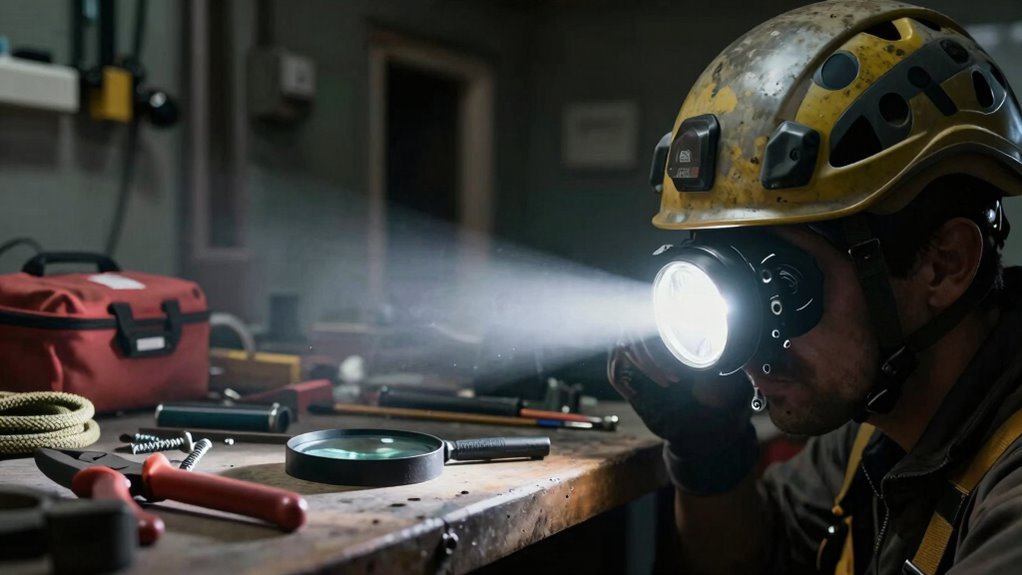
Whether you’re wrestling with a stubborn bolt under the hood, scaling a rocky cliff at dusk, or responding to a late-night emergency, having the right amount of light makes all the difference.
For repairs, aim for 300–500 lumens with a wide, adjustable beam—flood for the whole engine bay, spot for inspecting that sneaky oil leak.
Climbing? 300–600 lumens gives you trail vision without weighing you down, and a switchable beam helps you spot handholds or check the path ahead.
Emergencies demand serious power: 1,000+ lumens cuts through pitch-black chaos, with some beams reaching over 600 feet.
A boost mode’s handy when you need a burst of “what’s out there?!”
Just don’t shine it at your buddies—nobody likes a headlamp ninja.
Adjusting Brightness for Night Vision and Safety
How’s your night vision holding up when that blinding beam hits?
One second you’re cruising, the next you’re squinting like you’ve seen the sun at midnight.
Bright LED headlights don’t just annoy—they impair, especially as you age or face blue-light scatter that wrecks your dark adaptation.
But you’ve got options to stay safe and keep your eyes happy.
- Aim your headlamps correctly so you don’t blind others—or get blinded
- Use yellow-tinted lenses to cut blue glare and boost contrast on the fly
- Switch to red or green light modes to preserve night vision during late adventures
- Lower the brightness; sometimes less light means safer, clearer vision
- Give your eyes time to recover after glare—it’s not just you, it’s science!
Smart lighting keeps you sharp, safe, and smiling past sunset.
Frequently Asked Questions
How Many Lumens Do I Need for Urban Walking?
You’ll want 100 to 150 lumens for urban walking—it’s bright enough to spot cracks and curbs but won’t drain your battery fast.
If streets are well-lit, you can even dial it down to 50.
Throw on red mode sometimes; it’s like night vision mode for city adventures.
Just don’t blind your dog—he’s seen it all before.
Are Higher Lumens Better for Peripheral Vision?
No, higher lumens aren’t always better for your peripheral vision. Think of your eyes like a camera—too much light and everything gets washed out, especially at the edges.
You’re aiming for balance, not a spotlight.
Brightness can create glare, which actually blinds you more in the dark.
Do I Need a Strobe Mode for Safety?
Yeah, you do want strobe mode for safety—it’s like a superhero signal when things go sideways.
Flashing grabs attention fast, whether you’re lost, hurt, or just don’t want to become a snack for a mountain lion.
It disorients jerks, slices through fog, and screams “Hey! Look here!” to rescuers.
Just don’t startle your camp buddy at 2 a.m.—trust me, nobody likes a flash-happy ninja.
Can I Use a Headlamp for Photography Lighting?
You bet you can use a headlamp for photography lighting—it’s like turning yourself into a human spotlight!
Just keep it above 100 lumens for a visible beam, especially in fog or steam.
Warm light around 3000K looks cozier in shots, and a red mode?
Perfect for sneaking around like a ninja without killing your night vision.
Try swinging it slowly for cool light trails—fun and freakin’ easy!
Is Water Resistance Related to Lumen Output?
Nope, water resistance isn’t tied to lumen output—you’re not getting brighter light by splashing harder!
IPX ratings protect the guts of your headlamp from rain or dips, while lumens just measure light brightness.
Think of it like a raincoat for your lamp: keeps it safe, doesn’t boost its glow.
So, you can have a dim but dunk-proof light, or a super-bright one that flees at a sprinkle.
Totally separate superpowers!
Conclusion
Think of your headlamp like a flashlight orchestra—sometimes you need a full symphony, but other times, a solo flute does the trick. Too bright, and you blind your own night vision; too dim, and you’re fumbling like a bear in a tent. Match lumens to your mission, balance battery life, and you’ll light up adventures without missing a beat. Sweet spot? It’s out there—go find it, trail star!
References
- https://blueprintlighting.com/pages/understanding-light-measurements-lumens-and-kelvin
- https://www.apexlighting.com/glossary/lumen/
- https://www.commercial-lighting.net/what-is-a-lumen/
- https://newhavendisplay.com/blog/nits-vs-lumens-vs-luminance-key-differences-explained/
- https://www.foxfury.com/measuring-light-lumens-vs-lux/
- https://the-edit.lumens.com/the-guides/light-bulb-facts-the-meaning-of-lumens/
- https://www.louispoulsen.com/en-us/guides-inspiration/understanding-lumens-brightness
- https://en.wikipedia.org/wiki/Lumen_(unit)
- https://www.energy.gov/energysaver/lumens-and-lighting-facts-label
- https://droppe.com/blog/article/how-to-determine-the-ideal-lumen-output-for-your-work-headlamp/