5 Best Water Filters for Hiking That Keep You Hydrated Anywhere
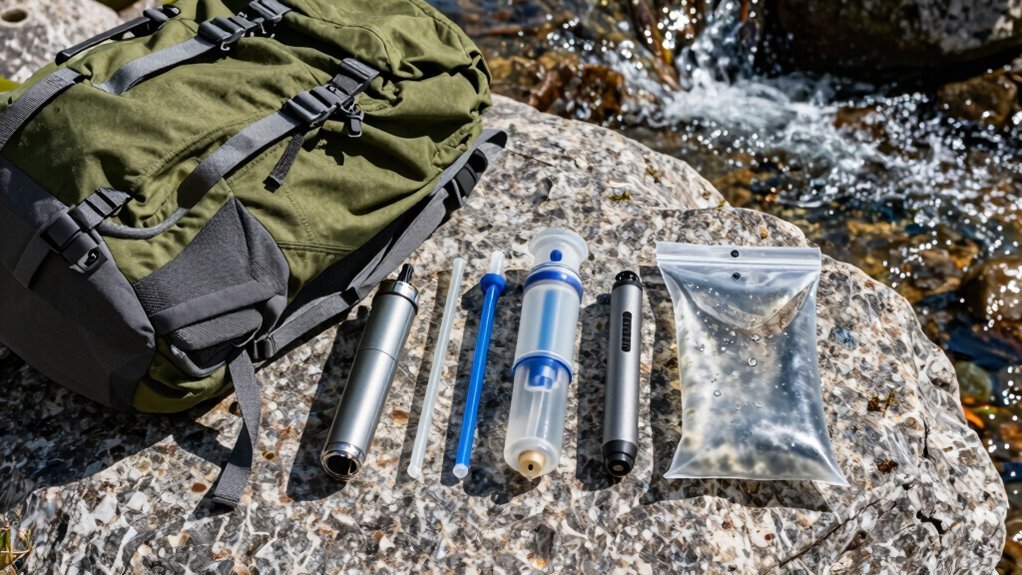
What if your next sip of water could come from a murky stream and still be safer than a tap?
The best water filters for hiking make this possible, removing up to 99.999999% of bacteria and protozoa.
LifeStraw’s 2-ounce design weighs almost nothing and fits in any pack.
Its hollow fiber membrane filters down to 0.2 microns, making it one of the top choices for ultralight hikers seeking reliable protection.
The Sawyer Mini offers 0.1-micron precision and a versatile inline or straw configuration.
This compact filter excels in backcountry scenarios where durability and microplastic removal down to 1 micron matter.
| LifeStraw Personal Water Filter for Outdoor Use | Best Overall | Bacteria Removal: 99.999999% | Protozoa Removal: 99.999% | Microplastics Removal: Removes down to 1 micron | VIEW LATEST PRICE | Read Our Analysis | |
| Sawyer Products Mini Water Filtration System | Most Versatile | Bacteria Removal: 99.99999% | Protozoa Removal: 99.9999% | Microplastics Removal: 100% | VIEW LATEST PRICE | Read Our Analysis | |
| LifeStraw Personal Water Filter | Best for Portability | Bacteria Removal: 99.999999% | Protozoa Removal: 99.999% | Microplastics Removal: 99.999% | VIEW LATEST PRICE | Read Our Analysis | |
| Squeeze Water Filtration System | Best for Groups | Bacteria Removal: 99.999999% | Protozoa Removal: 99.9999% | Microplastics Removal: 100% | VIEW LATEST PRICE | Read Our Analysis | |
| Katadyn BeFree 1L Water Filter Bottle | Fastest Flow | Bacteria Removal: 99.9999% | Protozoa Removal: 99.9% | Microplastics Removal: Not specified | VIEW LATEST PRICE | Read Our Analysis |
More Details on Our Top Picks
LifeStraw Personal Water Filter for Outdoor Use
If you’re the kind of hiker who wants lightweight reliability without sacrificing serious filtration power, the LifeStraw Personal Water Filter might just be your go-to trail companion. After all, how many straws let you drink straight from a sketchy alpine stream with 99.999999% confidence against bacteria like E. coli and Salmonella?
You’re also covered against parasites like Giardia and Crypto with 99.999% removal, plus microplastics down to 1 micron and turbidity reduced to 0.2 microns. That means even murky water comes out clean and safe to drink.
It’s been tested in labs using US EPA, NSF, and ASTM standards, so you know it’s legit. With a solid 4,000-liter (1,000-gallon) lifespan, it’s built for long-term use in the wild or emergencies.
You’ll appreciate that it’s BPA-free and doubles as a preparedness staple. And hey, every time you buy one, a schoolchild gets safe water for a year—so your hike helps hydrate someone else’s future. Not bad for a straw.
- Bacteria Removal:99.999999%
- Protozoa Removal:99.999%
- Microplastics Removal:Removes down to 1 micron
- Filter Lifespan:4,000 liters (1,000 gallons)
- Weight:<2 oz (46 g)
- Use Case:Camping, hiking, emergency preparedness
- Additional Feature:Direct drinking straw design
- Additional Feature:BPA-free construction
- Additional Feature:Funds safe water for children
Sawyer Products Mini Water Filtration System
You’re going to love the Sawyer Products Mini Water Filtration System if you’re a hiker, camper, or traveler who values lightweight gear without sacrificing performance. This palm-sized, 2-ounce filter packs serious capability into a minimalist design.
It removes 99.99999% of bacteria (like E. coli and Salmonella) and 99.9999% of protozoa (including Giardia and Cryptosporidium). Bonus—it filters 100% of microplastics thanks to its 0.1-micron absolute hollow fiber membrane.
Rated for up to 100,000 gallons and tested three times per unit, it’s absurdly durable. You can screw it onto most 28mm bottles, connect it to hydration packs, or use it as a straw—talk about versatility.
- Bacteria Removal:99.99999%
- Protozoa Removal:99.9999%
- Microplastics Removal:100%
- Filter Lifespan:100,000 gallons
- Weight:2 oz
- Use Case:Outdoor recreation, hiking, camping, travel, emergencies
- Additional Feature:Attaches to hydration packs
- Additional Feature:Includes cleaning plunger
- Additional Feature:Test verified three times
LifeStraw Personal Water Filter
The LifeStraw Personal Water Filter is ideal for ultralight backpackers who prioritize minimal weight without sacrificing reliable protection—because when you’re sipping straight from a mountain stream, you want assurance, not guesswork.
You’re getting 99.999999% bacteria (think E. coli, Salmonella) and 99.999% parasite (Giardia, Cryptosporidium) removal—all in a device that weighs under 2 oz (46 g). It filters up to 1,000 gallons (4,000 L), delivering safe drinking water for one person over five years.
With unlimited shelf life and brutal-world testing, it’s durable, yes, but also—let’s be real—just a straw: no bottle, no pump, no speed.
And hey, at least you’re helping give a child a year of clean water with every purchase.
- Bacteria Removal:99.999999%
- Protozoa Removal:99.999%
- Microplastics Removal:99.999%
- Filter Lifespan:1,000 gallons (4,000 L)
- Weight:<2 oz (46 g)
- Use Case:Outdoor use, emergencies, long-term storage
- Additional Feature:Unlimited shelf life
- Additional Feature:Ultralight durable build
- Additional Feature:Drink directly from source
Squeeze Water Filtration System
At just 71 grams, the Sawyer Squeeze Water Filtration System is an ultralight favorite among backpackers who value minimal pack weight without sacrificing performance. Its compact design makes it ideal for backcountry adventures where every ounce counts.
It removes 99.999999% of bacteria and 99.9999% of protozoa, including threats like E. coli and Giardia. This high level of filtration ensures safe drinking water straight from natural sources.
You can drink directly from streams, squeeze filtered water into bottles, or set up a gravity system using standard 28 mm threads. This versatility allows for convenient hydration in various backcountry scenarios.
With a maximum flow rate of 1.7 liters per minute, it delivers fast filtration when time matters. Backed by a lifetime warranty, the Sawyer Squeeze is built to last through countless adventures.
However, it’s not designed for extreme temperatures—avoid using it in water hotter than 40°C. Do not use in boiling hot springs, as high heat can damage the filter.
- Bacteria Removal:99.999999%
- Protozoa Removal:99.9999%
- Microplastics Removal:100%
- Filter Lifespan:Not specified
- Weight:2 oz (71 g)
- Use Case:Outdoors, travel, emergencies
- Additional Feature:Inline hydration compatible
- Additional Feature:Manufacturer lifetime warranty
- Additional Feature:Reusable collapsible pouches included
Katadyn BeFree 1L Water Filter Bottle
Light as a candy bar and just as packable, the Katadyn BeFree 1L Water Filter Bottle is every ultralight hiker’s secret weapon—especially when every ounce counts and you’d rather not trade safety for convenience. You’re getting a 0.1-micron hollow fiber filter that nukes 99.9999% of bacteria (like *Klebsiella terrigena*) and 99.9% of protozoa (*Giardia*, *Cryptosporidium*).
All of this comes in a 2.3 oz (63 g) collapsible Hydrapak Soft-Flask—perfect for stuffing into side pockets or running vests. No, seriously, how do you fit lab-grade filtration into something that light?
Free Flow Channels deliver 2 liters per minute—fast enough for one, tight for two—and with up to 1,000-liter lifespan, maintenance’s a breeze. Just shake or swish the EZ-Clean Membrane; no backflushing or tools required.
The Stay Clean nozzle resists gunk, it’s BPA-free, and Swiss-made for durability. Backed by a 2-year guarantee, it’s a filter that practically disappears in your pack.
- Bacteria Removal:99.9999%
- Protozoa Removal:99.9%
- Microplastics Removal:Not specified
- Filter Lifespan:Up to 1,000 liters
- Weight:2.3 oz (63 g)
- Use Case:Hiking, trail running, backpacking, ultralight use
- Additional Feature:Collapsible soft-flask design
- Additional Feature:Shake-to-clean filter
- Additional Feature:2-year product guarantee
Factors to Consider When Choosing Water Filters for Hiking
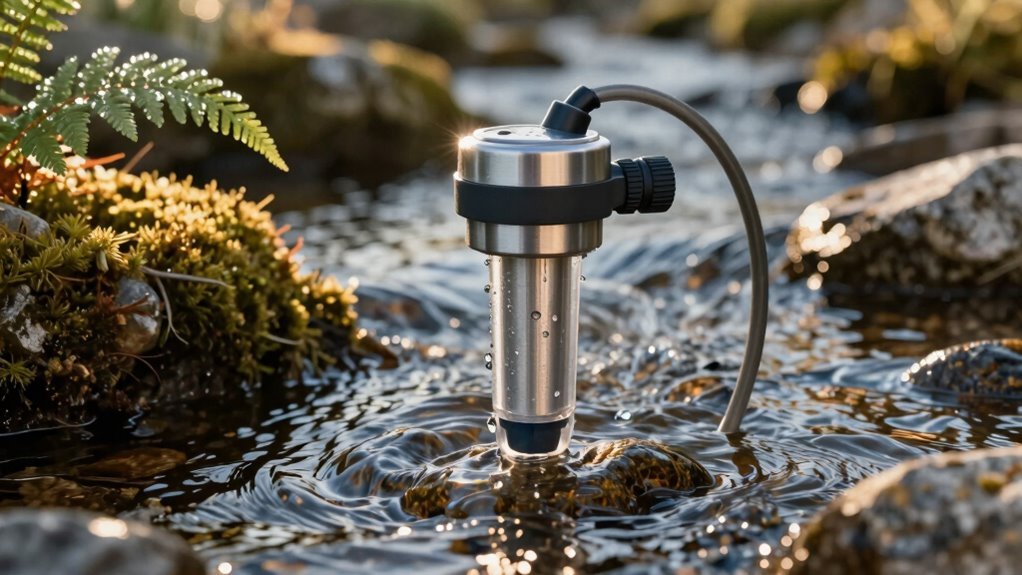
You’ll want to balance filtration efficiency—think 0.1 to 0.3 microns for bacteria and protozoa—against how much you’re willing to carry, since weight and portability often make or break a filter on long stretches of trail. Sure, you could lug around a heavy system that filters to 0.01 microns, but is that extra safety worth slowing you down when most backcountry threats are handled at 0.2? Flow rate, ease of use, durability, and repairability all stack up fast in real-world use—wouldn’t you rather avoid clogging every third sip or patching a cracked housing in the rain?
Filtration Efficiency
Purity isn’t just a promise—it’s a measurement, and when you’re filtering water on the trail, the difference between 99.999% and 99.999999% removal matters more than marketing slogans. You’re counting on your filter to block bacteria like E. coli and Salmonella—most top models deliver 99.9999% to 99.999999% removal, thanks to absolute 0.1-micron pores that stop pathogens cold.
Parasites like Giardia and Cryptosporidium? They’re trickier, but 99.999% reduction is standard, which—let’s be real—is pretty solid when you’re miles from help. Want microplastics gone? Many filters claim 100% removal down to 1 micron or smaller, though independent lab results vary.
And while turbidity reduction—bringing muck down to 0.2 microns or less—won’t save you from viruses, it does make murky puddles look suddenly drinkable. So, is “clean” always sterile? Nope—but with tight mechanical filtration, it’s damn close.
Weight and Portability
Shaving grams off your pack starts with smart filter choices—because when every ounce counts, a 2-ounce (57 g) purifier isn’t just convenient, it’s a trail-tested advantage. You’ll find ultra-light models under 2 ounces (46 g), some even hitting 2 ounces (71 g) with palm-sized builds that slip into side pockets or crush down in your pack.
Think about it: why carry clunky gear when collapsible pouches or threaded bottles (hello, 2.75-inch diameter) cut both weight and bulk? Inline or direct-to-mouth filters skip extra parts, trimming setup to just you and the water source—no fuss, no extra ounces.
At roughly 4 x 2.5 x 7.5 inches, many fit snug in hand or dock straight onto bottle threads, so you’re not lugging inefficient shapes. Sure, lighter sometimes means trade-offs, but not here—not when efficiency and portability actually sync up.
Ease of Use
While trekking through rough terrain, you’ll want a water filter that keeps up without slowing you down. Look for inline or bottle-integrated models with a 0.1 micron absolute rating—they block bacteria and protozoa like Giardia and Cryptosporidium without complicated setup or extra gear.
You’ll love how lightweight options—around 2 ounces—slip right into your pack, barely registering on the scale after mile ten. These manually operated systems require no batteries and no fuss—just pump or sip and go.
Need water fast—right now? Choose a filter with standard bottle threads or pouch compatibility so you can refill or drink directly, skipping extra steps.
Maintenance should feel like second nature, not a chore. Imagine backflushing in 30 seconds or shaking clean with a quick swirl—no time for intricate routines mid-hike.
Stick with designs that make filtering as simple as twisting a cap or taking a breath. When nature calls for hydration, you shouldn’t need a manual.
Durability and Build
Your water filter better survive the same rocks, drops, and rogue pack tumbles you do—so look for one built with BPA-free plastics and rugged, ultralight housings that shrug off impacts without adding heft, typically staying under 2 ounces (46 grams). These filters often last up to 1,000 liters (about 4,000 gallons), meaning you won’t replace it every other trail season—unless you’re filtering Sahara runoff, maybe.
A 0.1-micron absolute pore size isn’t just small; it’s tough enough to block nasties while keeping the body from cracking under pressure or freezing temps. Designs that let you shake, swirl, or backflush with no tools? They’re not just convenient—they extend lifespan.
And hey, would a company stand behind flimsy gear? Most offer 2-year warranties, so if it breaks prematurely, you’re covered. Durability isn’t luck—it’s engineered.
Flow Rate
You just made sure your filter can take a tumble down a scree slope without shattering—now let’s talk about what happens when it’s time to actually drink. How fast does water come through?
Some systems push out nearly 1.7 liters per minute, while direct-flow models can hit 2 liters per minute with enough effort—pretty sweet when you’re parched. But remember, your squeeze, pump, or sip directly controls the flow, so tired arms mean slower refills.
Higher rates are great for two people sharing, sure, but they demand more force or frequent action. And yeah, manufacturers quote ideal numbers—cold or murky water, even minor clogging, can drag that rate down fast.
Is sipping slowly really such a crime on day three of trail life? Maybe not, but when you’re rationing time at a sketchy puddle, speed counts.
Pick a flow you can sustain, not just one that looks good on paper.
Maintenance Requirements
How often do you actually clean your gear when you’re miles from the trailhead? Not often, so pick a filter that makes maintenance easy—like models with an EZ-Clean membrane you can rejuvenate with a quick shake or swirl, no tools needed.
You’ll skip the hassle of backflushing, save time, and still keep flow rates up to 2 L/min, even in silty or cloudy water. Regular debris removal prevents clogs, but don’t forget the long game: most cartridges top out around 1,000 liters before needing replacement.
It’s not just about cleaning—it’s about longevity. Look for built-in perks like stay-clean nozzles or collapsible pouches that reduce contamination during use and cleaning.
These small touches cut down on fumbling in the dirt with grimy hands. Sure, no filter’s zero-maintenance, but the right one makes upkeep quick, intuitive, and way less annoying—especially when you’re tired, hungry, and just want a safe drink.
Compatibility With Gear
What good is a water filter if it doesn’t play well with your gear? You need a system that integrates smoothly—many filters attach directly to standard 28 mm bottle threads or hydration packs, so you’re not stuck with extra accessories.
If you use a drinking pouch or collapsible soft flask, look for models that support inline filtration, letting water flow straight into your preferred container. Some filters even work as direct-from-source straws, no bottle required—handy when you’re lightening your load.
Inline units can pair with gravity setups or plug into compatible pouches, giving you flexibility across different hikes. Adapters and included pouches often bridge the gap between your filter and existing bottles or hydration bladders, ensuring you’re not limited by mismatched threads.
Choose wisely—compatibility saves weight, time, and frustration on the trail, especially when every ounce and second counts.
Frequently Asked Questions
Can I Use These Filters in Saltwater?
No, you can’t use these filters in saltwater. They don’t remove salt, so drinking filtered seawater will still dehydrate you. For saltwater, you’ll need a desalination device instead—these portable filters are made for freshwater sources only.
Do Water Filters Remove Viruses?
No, most water filters don’t remove viruses—you need a purifier for that. If you’re hiking where water sources might be contaminated with viruses, grab a UV purifier or chemical treatment to stay safe. Don’t risk it with just a filter.
How Long Do Filters Last Before Replacement?
You’ll typically replace your filter after 1,000 liters—like Sarah hiking the PCT who changed hers at mile 2,000. Usage conditions matter, so check manufacturer guidelines and swap it sooner if flow slows drastically or contamination levels are high.
Are Replacement Parts Easy to Find?
Yes, you can easily find replacement parts for most hiking water filters. Manufacturers stock them online, and outdoor retailers carry common models. You won’t struggle to replace what you need, so staying hydrated on the trail stays hassle-free whenever it’s time to swap something out.
Can I Freeze a Water Filter?
you shouldn’t freeze your water filter—it can crack the internals and ruin the membrane. if you’re in freezing temps, insulate it or stash it inside your pack at night. always store it warm to keep it working right when you need it.
Conclusion
You’re out there, miles from pavement, and your filter just saved you—again. Funny how a 2-ounce LifeStraw (99.999999% bacteria removal) or a 71-gram Squeeze (1.7 L/min) becomes your most trusted gear. Whether you’re slaking thirst from a creek or prepping for backcountry laps, these filters—each with lifespans from 1,000 to 100,000 gallons—make clean water no coincidence, just smart prep. Who knew staying alive could be this light?